NestVM · 2 min read
NestVM — how it was assembled
NestVM is the machine under CoAgnes. This note states how its present assembly was made and what it consists of.
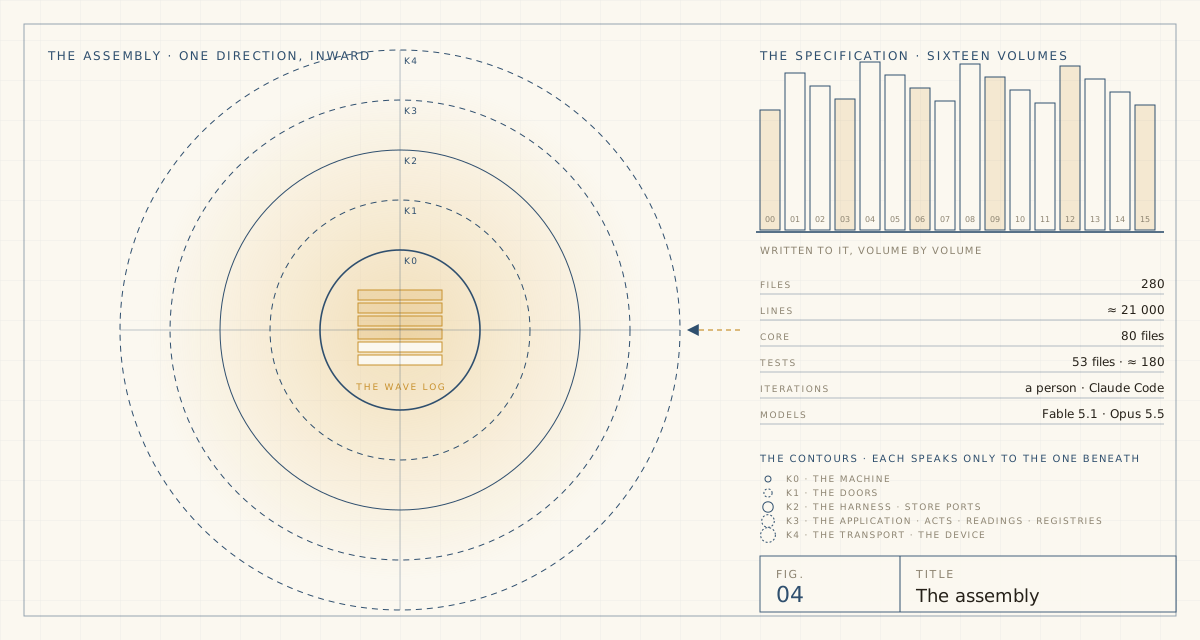
From the specification
- The source is the Nest Runtime Specification Set: sixteen volumes, published for study in CoAgnes Lab.
- The assembly was written to the specification, volume by volume, in iterations between a person and Claude Code — the models Claude Fable 5.1 and Claude Opus 5.5.
- One iteration: a volume or a section is read; code is written to it, with the section cited in the file's header; tests are written beside the code, citing the sections they prove; the person reviews and accepts or returns it.
- A conformance suite and the golden fixture of Volume 14 gate every change.
Size, at the time of writing (October 2026)
- About 280 TypeScript files and 21,000 lines in the library; 80 files in the core.
- 53 test files, about 180 tests, run on every change.
- One exported function per file; the file's header states which section of the specification it serves.
- The core has no dependency beyond Node 22 and TypeScript; a cloud store adapter loads its client only when mounted.
Architecture, in theses
- The wave log — an append-only sequence of immutable records is the machine's only memory.
- The register file — the machine's state, reified and journalled; written only through the state protocol, so that every change is on the record.
- Stations — activation knots (listeners), bind descriptors (doers), output controllers (crossings).
- The settle loop — the engine runs to quiescence, then the membrane discharges what is due to the world; answers re-enter as records.
- The Cell — a bounded local field in which delegated work runs under admission, assessment and review (Volume 12).
- Contours — the machine; the harness with its store ports; the application with its acts, readings and registries; the transport; the device. Each contour speaks only to the one beneath it.
- Stores as ports — in memory, in files, or in a document store; the machine does not know which.
- Controllers — the only access to the outside: deterministic stand-ins, a scripted world, or a model through a provider; every answer names its source.
- Programmes as data — every particular approach is a YAML record, never code.
- Readings as projections — what a surface shows is derived from the log; a page reloaded replays the same state.
Status
The assembly runs the workbench, the Atlas instrument and the recordings published in Lab. No package is published. NestVM is an independently governed project; CoAgnes assembles it.